 English
 简体中文
A 4515Q brake shoe is ordered by five numbers that have to agree with each other: 16.50 in (419.1 mm) drum diameter, 7.00 in (177.8 mm) lining width, 0.730 in (18.5 mm) nominal lining thickness, the Q-series web profile, and the rivet pattern that ties lining to table. Miss one and the shoe still bolts onto the anchor; it simply stops worse, runs hotter and wears the drum unevenly.
What the 4515Q Designation Actually Specifies
The 4515Q code identifies a heavy-duty drum brake shoe sized for a 16.50 in (419.1 mm) brake drum with a 7.00 in (177.8 mm) wide lining, built on the Q-series shoe profile and catalogued under the Friction Materials Standards Institute (FMSI) numbering system.
FMSI numbering exists so a distributor can match a shoe to a foundation brake without holding the original equipment part number in front of them. The four-digit base number points to the size family and the general shoe shape; the trailing letter marks a distinct variant of that base shoe. That detail carries commercial weight, because 4515 and 4515Q share the same 16.5 in by 7 in envelope, and the neighbouring 4707Q sits in the same working space as well. The suffix is often the only thing standing between the correct part and a comeback.
A 4515Q brake shoe is a riveted or bonded drum brake shoe assembly whose table and web are dimensioned for a 16.50 in (419.1 mm) inside-diameter drum, whose lining is 7.00 in (177.8 mm) wide, and whose identity combines FMSI base number 4515 with the Q-series profile suffix.
Treat the suffix as a drawing reference rather than a label on a box. Two shoes with the same drum diameter can differ in table radius, web height, rivet pitch and lining segment count, and those are the details that decide whether the lining sits flat against the drum face or stands proud of it.
4515Q Brake Shoe Specifications at a Glance
The dimensional envelope of a 4515Q shoe is fixed at a 16.50 in drum diameter and a 7.00 in lining width; every remaining value, from lining thickness to rivet pitch, has to be confirmed against the supplier drawing.
| Parameter | Nominal value | Confirm with |
| Drum diameter | 16.50 in (419.1 mm) | Measured drum bore and published drum wear limit |
| Lining width | 7.00 in (177.8 mm) | Drum width and shoe table drawing |
| Lining thickness | 0.730 in (18.5 mm) | Supplier drawing and a removed sample |
| Shoe profile | Q-series, marked by the Q suffix | Table radius and web height on the drawing |
| Lining attachment | Riveted or bonded, per part number | Rivet hole count, rivet pitch and bond line spec |
| Friction data | Friction coefficient curve | Dynamometer report covering fade and recovery |
| Performance basis | FMVSS 121 for air-braked heavy vehicles | Vehicle-level test report from the brake supplier |
| Quality system | IATF 16949:2016 | Certificate scope, production site and expiry date |
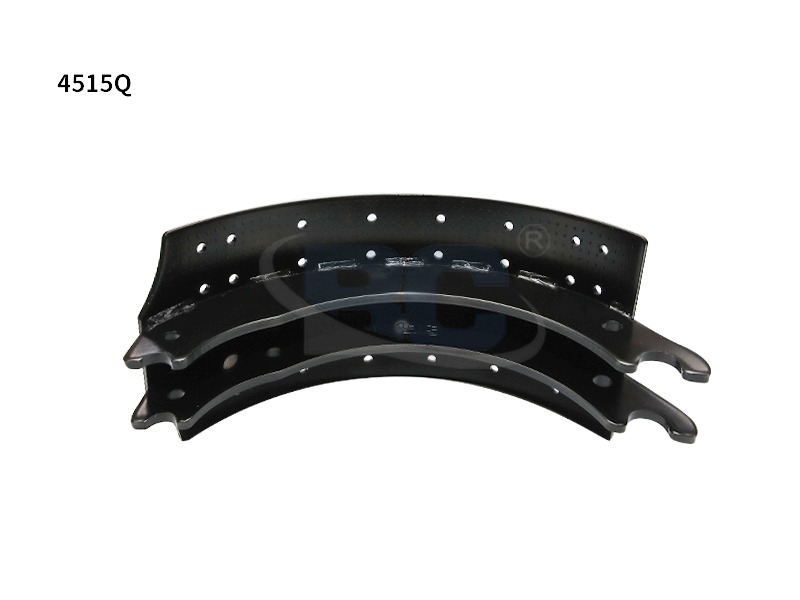 Custom 4515Q Steel Brake Shoe, 16.5 by 7 InchSpecification reference for the 4515Q steel brake shoe, listing 16.5 in drum diameter, 7 in lining width and 32 rivet holes for drawing checks.View Product →
The drum diameter in that table is a nominal figure. A worn drum measures larger, so a new shoe has further to travel before it touches the friction surface, and the slack adjuster gives up stroke that should be held in reserve. Measure the bore at two positions 90 degrees apart, compare the readings with the drum's published wear limit, and replace the drum once it is past that limit rather than fitting new shoes into an oversized bore.
How 4515 and 4515Q Differ, and Why the Suffix Matters
The 4515 base shoe and the 4515Q share the 16.5 in by 7 in envelope, but the Q suffix signals a different web and table profile and frequently a different lining retention detail, so the two cannot be swapped on the same anchor without drawing confirmation.
4515 base design
- Drum and lining envelope: 16.50 in by 7.00 in.
- Web and table geometry follow the base drawing.
- Correct where the foundation brake was built for the base shoe.
4515Q variant
- Drum and lining envelope: 16.50 in by 7.00 in.
- Q-series web and table geometry, including rivet line position.
- Correct only where the Q profile is specified on the anchor or the service manual.
A rivet row that sits slightly off the Q line will stand the lining proud of the table. The shoe then rides on rivet heads instead of friction material, the lining never beds in across its full width, and the drum scores well before the lining reaches its wear limit.
Material, Lining Compound and Friction Behaviour
A 4515Q shoe stops a truck only as well as its friction pair allows: the steel or cast table and web control shape retention, and the lining compound sets the friction coefficient that the foundation brake turns into torque.
- Steel table and web: welded construction, lighter than cast, and dependent on weld quality at the table-to-web joint.
- Cast table and web: heavier section, damps vibration, holds shape through heat cycling on severe duty cycles.
- Riveted lining: mechanical retention, replaceable in the field, provided rivet heads stay below the friction surface.
- Bonded lining: continuous contact area with no rivet heads, dependent on surface preparation and cure control at the bond line.
Friction coefficient is the number that carries the performance claim. FMVSS 121 sets the dynamometer and stopping performance that air-braked trucks, tractors and trailers must meet, and a lining that fades outside its temperature window fails the fade and recovery stages of that test no matter how well the shoe itself is built.
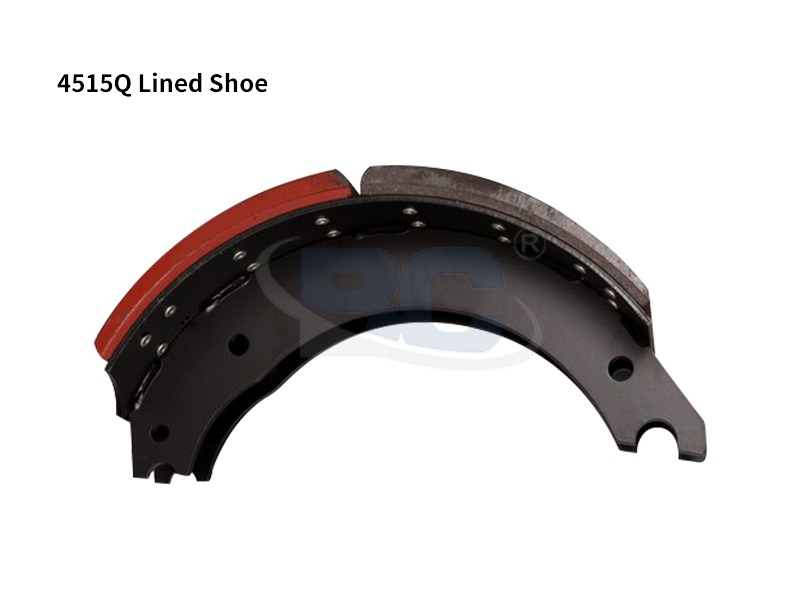 Custom 4515Q Lined Brake Shoe, 16.5 by 7 InchProduct identification for the 4515Q lined brake shoe, with 16.5 in by 7 in size and 32 rivet holes; request friction curve data separately.View Product →
Ask for the curve, not the adjective. A lining datasheet that reports friction coefficient at a single temperature tells a buyer very little. Request the friction curve across the working range, plus fade and recovery results from the dynamometer run, then compare those results with the duty cycle the vehicle actually sees: loaded line-haul, regional distribution, tipper work on grades, or trailer service.
Tolerances That Decide Whether the Shoe Runs True
Radial runout between the shoe table and the web bore is the tolerance that most reliably predicts whether a 4515Q will bed in evenly, and a common drawing callout for heavy-duty shoes is 0.2 mm maximum.
Runout is checked by rotating the shoe about its bore and reading a dial indicator against the table face. A table that is out of round beyond the callout creates a high spot that contacts the drum first, heats a narrow band, and can crack the lining at that point long before the rest of the shoe is worn.
Weld quality at the table-to-web joint matters as much as the number itself. Incomplete penetration leaves a shoe that flexes under cam load, and the symptom appears as uneven lining wear across the width of the shoe rather than as an obvious breakage. Ask for the welding procedure and the inspection record, not only a dimensional report.
The link between drawing tolerances and structural behaviour in this shoe family is set out in more detail in a dimensional tolerance and structural integrity analysis for 4515Q brake shoes.
Rust jacking is the second tolerance killer, and it happens after the part leaves the factory. Corrosion product builds between lining and table, lifts the lining off its seat, and drives rivets or the bond line into the drum. A coated table and a dry, sealed interface between lining and steel are the practical defences, and both belong in the purchase specification.
What Buyers Should Verify Before Placing a 4515Q Order
A 4515Q order is only safe when five documents line up: the dimensional drawing, the friction report, the quality certificate, the packaging specification and the cross-reference list.
- Cross-reference in both directions, FMSI number and original equipment number, on paper, before the purchase order is raised.
- Request the drawing with tolerances rather than a photograph with dimensions written over it.
- Ask for friction coefficient data plus fade and recovery results from a dynamometer run.
- Confirm the lining attachment method matches the anchor and the vehicle service manual.
- Check that the quality certificate covers brake shoe manufacture at the production site, not only at a trading office.
- Specify marking and carton labels so 4515Q stock cannot be confused with 4515 or 4707Q stock in the warehouse.
One mismatch is expensive. When a 4515Q carton holds a shoe with the neighbouring rivet line, the error usually surfaces after installation, once the drum scores or the lining cracks. Agree the batch inspection record and the marking scheme before the first shipment, and keep a retained sample from each batch for comparison.
 4515Q Lined Brake Shoe Kits from Zhejiang BangchiLined brake shoe kit listing for 4515Q; confirm size, rivet holes and OE cross-reference with the supplier before batch approval.View Product →
Zhejiang Bangchi Auto Parts Co., Ltd. is one of the manufacturers working to this pattern. The company states a production line rated at 2,000,000 brake shoes per year, IATF 16949:2016 certification, and a catalogue organised by FMSI number across steel shoes, cast shoes, linings, lined shoes and repair kits. Its company profile sets out the manufacturing base and quality system, which is the level of detail a buyer should expect before adding a supplier to an approved list.
4515Q Brake Shoe Questions From the Parts Counter
Is a 4515Q shoe the same as a 4515 shoe?
No. Both are dimensioned for a 16.50 in drum and a 7.00 in lining, but the Q suffix identifies a different web and table profile. Cross-list them only after the anchor and the rivet line have been checked against both drawings.
What drum diameter does a 4515Q fit?
A 4515Q fits a nominal 16.50 in (419.1 mm) inside-diameter brake drum with a 7.00 in (177.8 mm) wide lining. Confirm the measured bore against the drum's published wear limit before new shoes go on.
How much lining should remain before a 4515Q is replaced?
Replace the shoe when the remaining lining reaches the minimum stamped on the shoe or published in the vehicle service manual, and always before rivet heads or the bond line are exposed. A widely used field threshold is roughly 3 mm of lining above the rivet heads, while the original equipment minimum overrides it. Measured lining thickness, not mileage, is the deciding number.
Does IATF 16949:2016 certification guarantee a good 4515Q shoe?
No. IATF 16949:2016 certifies that the quality management system meets the automotive standard; it does not certify the dimensions or friction performance of a specific shoe. Ask for the batch inspection record and the friction report alongside the certificate.