 English
 简体中文
Brake shoe quality control for bulk heavy-duty truck orders is a defined set of inspection parameters, measurement methods, and sampling rules applied to every production lot before shipment, not a final visual check. A 0.5 mm error in the anchor hole position of a steel brake shoe can misalign the brake lever, cause uneven lining wear, and turn a 1,500-piece order into a return claim at the customer's dock.
Because a bad lot means freight costs, downtime, and warranty claims, bulk buyers specify quality control limits before production. A manufacturer with 20 years of brake product experience and a 2-million-shoe annual line capacity, Zhejiang Bangchi Auto Parts Co., Ltd., treats each lot as a measurable output of the quality system described in its company profile.
Why Bulk Brake Shoe Orders Fail Incoming Inspection
Most bulk brake shoe rejections trace back to dimensional drift, lining bond failure, or rust damage, not to one dramatic manufacturing defect. Pre-production samples look clean because fresh tooling and skilled operators are in control; when a line runs thousands of pieces, punch wear, curing variation, and coating drift create the defects the inspection plan must catch.
Reject records across heavy-duty shoe production cluster into five categories every year:
- Dimensional deviation on holes, web width, and arc profile.
- Lining bond failure or delamination at the friction-to-metal interface.
- Rust and coating defects after transit or storage.
- Rivet height issues, hole misalignment, and damaged hardware.
- Marking, packaging, and documentation errors.
The cost of finding a defective brake shoe at the customer's incoming inspection is eight to ten times higher than catching the same defect at the manufacturer's final line.
Dimensional Inspection Parameters That Decide Fit
Dimensional accuracy is the first parameter to settle because it decides whether the shoe seats correctly on the chamber lever and drum. Drawing references follow OE prints and FMSI numbering, with tighter tolerance on holes and contact surfaces and practical tolerance on non-critical features.
In a bulk order, the inspection plan needs a clear tolerance statement for every dimension that affects assembly and braking torque.
| Parameter | Critical dimension | Typical tolerance | Inspection method |
| Web width | 200 mm / 220 mm classes | +/-0.2 mm | Caliper or CMM |
| Anchor and lever hole diameter | 22 mm / 28 mm | +0.05 mm / 0 | Plug gauge |
| Hole center distance | Per FMSI drawing | +/-0.3 mm | Coordinate fixture |
| Shoe arc radius | Per OE profile gauge | 0 to +0.5 mm | Profile template |
| Overall height toe to heel | Per drawing | +/-0.5 mm | Height gauge |
| Lining width on lined shoes | Per drawing | +/-0.3 mm | Caliper |
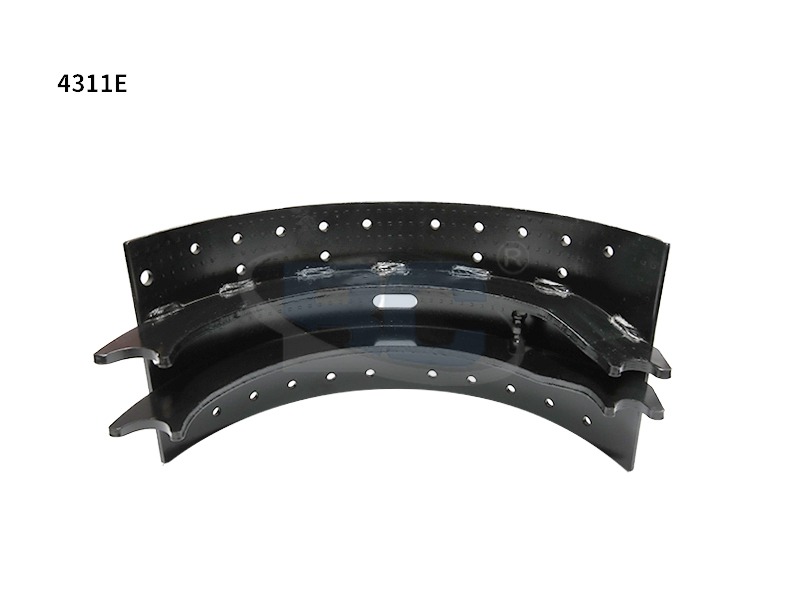 4311E Brake Shoe with 28 Rivet Holes for BPW AxlesThis 16.5" x 7" shoe family serves as the base for lined platforms, so verifying dimensional tolerances here directly affects assembly fit and braking torque consistency.View Product →
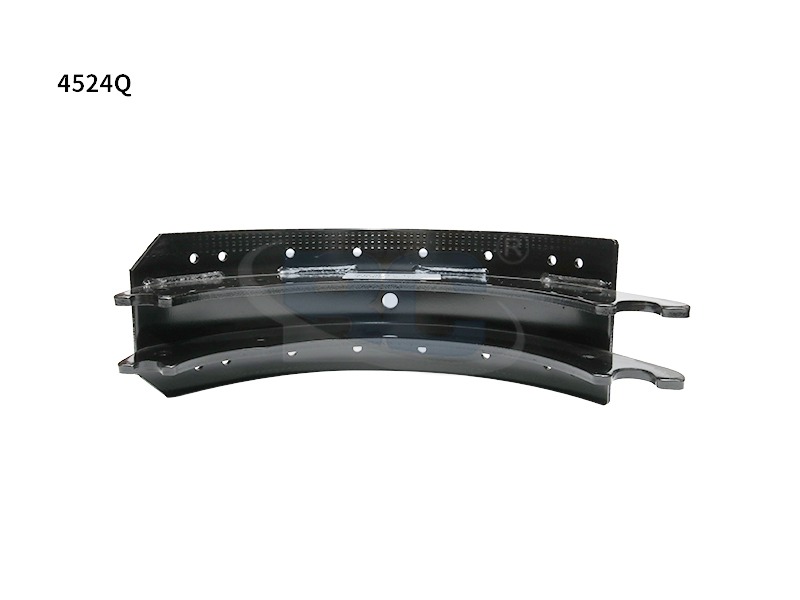
Every FMSI reference, from the 4311E steel shoe family to lined shoe platforms, needs this dimensional discipline before lining and coating stages begin.
Hardness and Metallurgical Checks for the Shoe Body
The shoe body must meet defined hardness and tensile ranges so it does not deform under the dynamic loads of a loaded truck or trailer at emergency braking. Steel brake shoes are normally formed from low-carbon steel strip, while casted brake shoes use iron grades that require microstructure control; both need chemistry and hardness verification, not just a visual inspection.
For bulk acceptance, use a sampling rule that covers process variation:
- One hardness test per 50 pieces, with the measured position reported.
- One material certificate per heat covering carbon, manganese, silicon, phosphorus, and sulfur.
- One tensile and yield verification per material batch for formed steel shoes.
- Porosity and casting soundness checks for every casted shoe in the sample.
Friction Lining and Bonding Integrity
Lining bond and friction material quality decide whether a lined brake shoe reaches its expected service life without delamination or uneven wear. The two most frequent causes of lined-shoe rejection are rivet countersinking depth and shear strength below the agreed minimum, so the inspection plan must name the exact test for both.
Agree on the test sequence before the first production lot:
- Shear test of the lining-to-shoe bond on a cold sample, reported in MPa.
- Visual check for blisters, burn marks, and edge delamination on every piece.
- Lining thickness and arc profile check after curing.
- Rivet head height and countersink depth check on every riveted shoe.
| Lining property | Acceptance requirement | Test method |
| Bonded shear strength | Minimum 1.5 MPa | Shear test rig |
| Hardness | 70 to 100 on the R scale | Rockwell R test |
| Thickness variation | +/-0.2 mm across the arc | Caliper |
| Density | 1.8 to 2.4 g/cm3 | Archimedes method |
| Surface condition | No cracks, blisters, or burn marks | Visual |
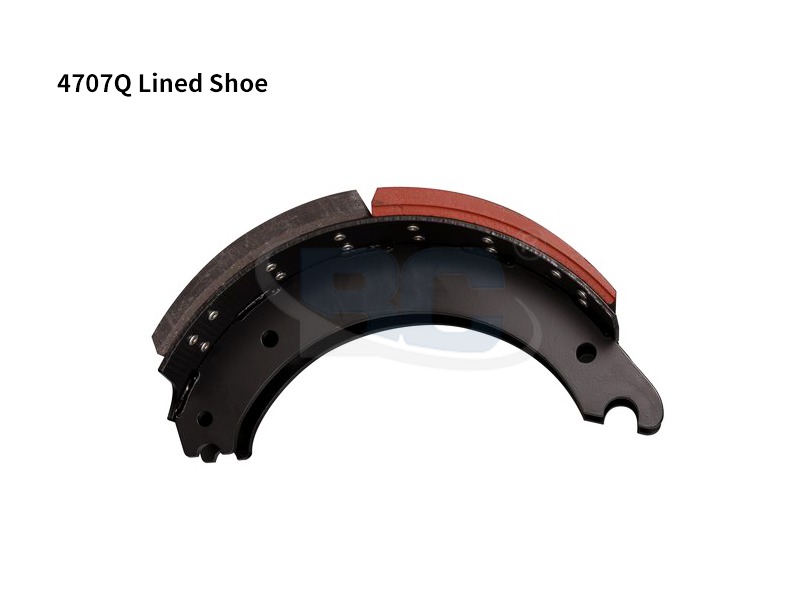 4707Q Lined Brake Shoe with OE Number 152.24724A 32-rivet-hole lined platform that supports BPW200 and VL225 applications; its dimensional checks are critical to preventing premature lining delamination in service.View Product →
For lined shoe platforms such as the 4707Q and for replacement linings, these checks are the boundary between a durable brake and a premature delamination claim.
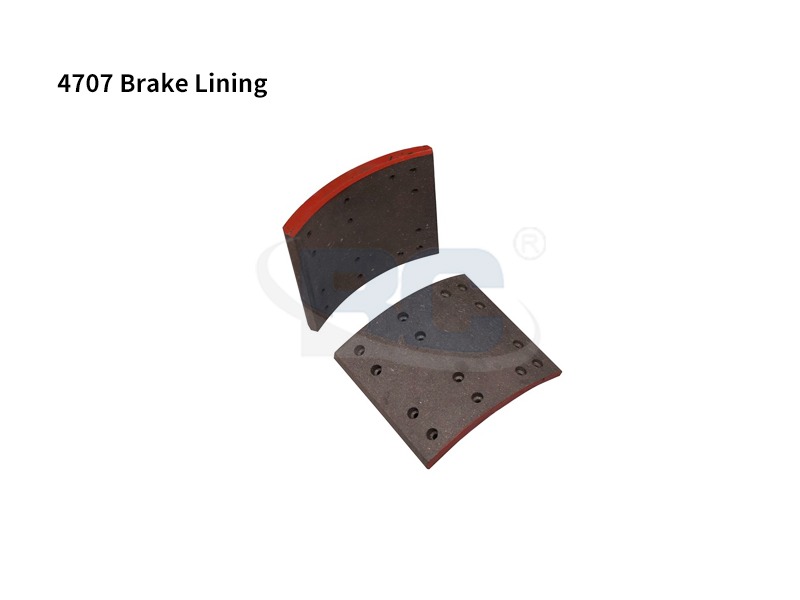 4707 Brake Lining with WVA 19030/33 ReferenceAvailable in 14 or 16 rivet hole patterns for 16.5" x 7" shoes; bond integrity must be treated as a safety-critical attribute during bulk inspection.View Product →
A delaminated lining is not a parts failure; it is a safety event. Bulk inspections should treat any sign of bond separation as a critical nonconformity, not a cosmetic issue.
Surface Treatment, Rust Protection, and Packaging
Rust protection is the most common hidden cause of bulk rejection, because a faultless metal part can be condemned by corrosion during a single ocean transit. The inspection plan must specify the coating system and the packaging moisture barrier, not only the paint color.
- Coating system: phosphate base, primer, and finish paint or powder coating.
- Minimum 48 hours neutral salt spray test per ISO 9227.
- Edge and hole coverage checked on stamped edges and drilled holes.
- Rust-preventive paper between shoes, a moisture barrier carton, and an export pallet per the agreed load plan.
- Pallet height limited to the agreed stacking plan to avoid transit deformation.
Sampling Plans, Documentation, and Traceability
A bulk brake shoe order without traceable records is an unmanageable risk, so documentation is the final control parameter that makes a shipment usable. Use a written sampling standard such as ISO 2859-1 with agreed AQL values; this avoids the two classic disputes of "inspect everything" and "inspect nothing."
- Inspection level II is the usual default for brake shoe lots.
- Assign AQL 1.0 for dimensional and functional parameters.
- Assign AQL 2.5 for visual attributes such as paint, marking, and packaging.
- Print the batch number on every carton and on the certificate of conformity.
For large orders, independent third-party testing of product samples validates that production units match the certified specification. A system audited under IATF 16949, as described in the IATF 16949 certification progress report of Zhejiang Bangchi, adds a third-party layer of control over factory tests.
A complete shipment file contains the dimensional report, material certificate, shear test record, salt spray result, AQL sampling record, and batch traceability chart. If any one document is missing, the lot is incomplete.
Frequently Asked Questions
What AQL level should I specify for brake shoe bulk orders?
Specify AQL 1.0 for dimensional and functional parameters and AQL 2.5 for visual attributes such as paint and marking, using inspection level II from ISO 2859-1 as the default sampling basis.
Why is hole position more critical than shoe width in brake shoe inspection?
Hole position controls the alignment of the brake lever and anchor pin. Even a small angular error at the lever translates into uneven lining pressure, lower brake torque, and edge wear, while a small difference in non-contact width rarely affects braking.
How do I verify lining bond strength on a delivered lot?
Request the shear test certificate for each batch and, if the contract allows destructive sampling, take one sample per 100 pieces for a cold shear test at a local laboratory.
Should steel and casted brake shoes use the same inspection parameters?
Dimensional and packaging parameters follow the same rules for both types; metallurgical criteria differ. Casted shoes need hardness, porosity, and soundness checks because casting defects are internal, while steel shoes need tensile and bend confirmation on the formed body.