 English
 简体中文
简体中文An RFQ that describes a brake shoe only as a replacement for an FMSI or OEM part number is a gamble. In a heavy-duty fleet procurement reviewed for this guide, the winning quote undercut the incumbent supplier by 21 percent, but the delivered shoes carried a table thickness 1.2 mm below the drawing tolerance; the fleet logged eleven premature brake inspections before the lot was pulled. The root cause was an assumed material grade, not an incorrect part number.
Brake shoe procurement for trucks and trailers needs an RFQ (request for quotation) that fixes geometry, metallurgy, friction material, quality evidence, and delivery terms before price negotiation starts. The parameters below prevent fitment failures, lining separation, and receiving-dock disputes.
Anchor the RFQ to a traceable part identity
The identity line of a brake shoe RFQ should name the FMSI number, the OEM reference, or both. An FMSI index number such as 4515, 4707, or 4718 is the friction material industry's standard identifier, and it gives suppliers an immediate cross-reference to the lining edge code and shoe profile they already catalogue.
For European platforms, add the axle builder's reference: a BPW 0509127830, a Volvo 3095196, or a SAF 3054012000 points to the exact shoe platform, including the old or new generation. Generation matters; a BPW old-generation shoe and a BPW new-generation shoe are not interchangeable even when the drum diameter looks identical.
A brake shoe RFQ is complete when an engineer who has never spoken to the buyer can reconstruct the required part from the document alone.
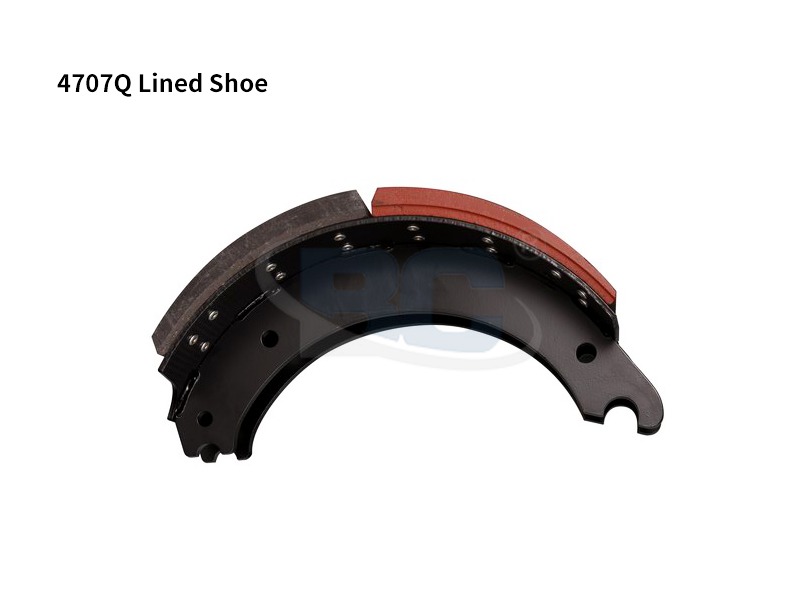
State the product category explicitly: bare steel brake shoe, casted brake shoe, lined brake shoe, or lined shoe kit. When the line item is a kit, the quotation scope expands to include the friction lining, the retaining hardware, and the assembly tolerance. A typical example is the 4707Q lined shoe kit, which combines the shoe, the lining, and the hardware in one serviceable unit.
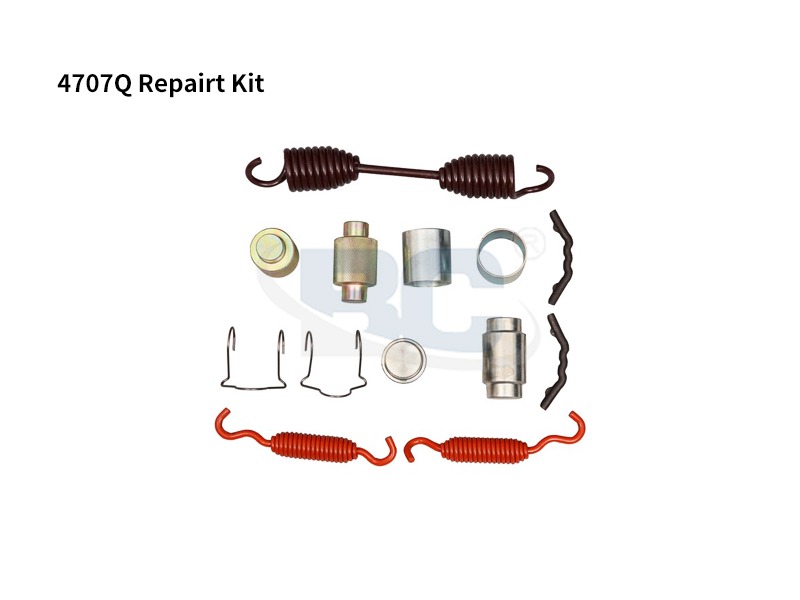 4707Q Lined Brake Shoe Kit for 16.5" x 7" ApplicationsThis lined shoe kit bundles the shoe, friction lining, and hardware into one serviceable unit, simplifying procurement and assembly for 16.5-inch by 7-inch drum brakes with 32 rivet holes.View Product →
State dimensions and tolerances in the drawing
Dimensional tolerances, not part names, decide whether a brake shoe seats correctly on the S-cam roller and inside the drum. The RFQ must reference a drawing or state the critical dimensions in the line item: shoe width, drum diameter, table thickness, web thickness, and hole positions with acceptable deviations.
Share of sampled heavy-truck brake shoe RFQs that state each parameter
| Parameter | Example value | Suggested tolerance | Why it matters |
| Shoe width | 200 mm | +/-1.0 mm | Matches the drum contact width and lining coverage |
| Drum diameter / arc | 420 mm | +/-0.5 mm | Shoe arc must conform to the drum bore geometry |
| Table thickness | 8 mm | +0.5 / -0.2 mm | Resists heat deformation under repeated braking |
| Web thickness | 6 mm | +/-0.3 mm | Carries the S-cam actuation load |
| Roller / anchor hole spacing | per drawing | +/-0.5 mm | Alignment with the brake spider and roller path |
| Rivet hole pattern | per drawing | +/-0.4 mm | Determines lining retention and replacement fit |
For an FMSI 4515Q application, the drawing should also specify the roller and anchor hole geometry unique to the Q-series platform and the flange width of the shoe table. When in doubt, send the drawing file; a supplier that checks the dimensions one by one is a stronger qualification signal than one that quotes immediately.
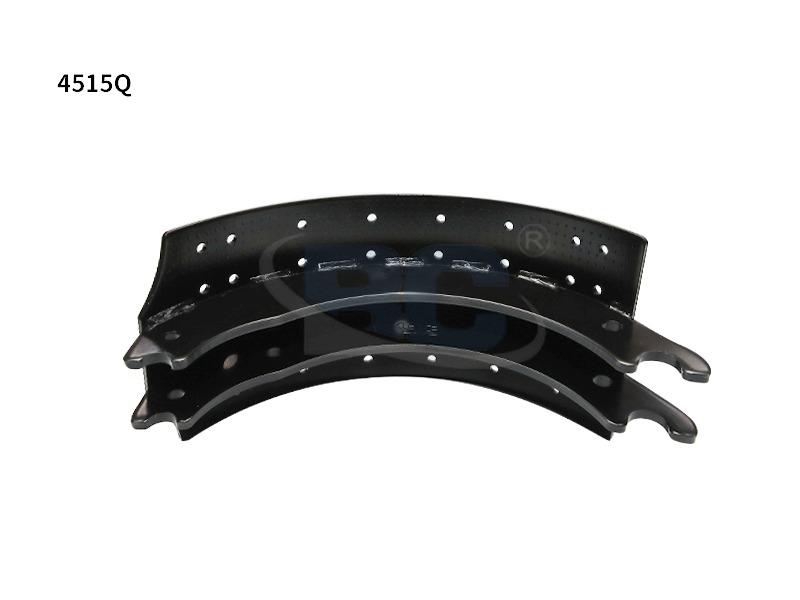 4515Q Brake Shoe with 16.5" x 7" Dimensions and 32 Rivet HolesThe FMSI 4515Q shoe demands precise roller and anchor hole geometry. This 16.5-inch by 7-inch shoe, with 32 rivet holes, fits Q-series platforms and matches OE number 152.05533.View Product →
Define material grade and hardness
A brake shoe table that fails in fatigue usually fails because the RFQ named no material grade and the supplier selected the least expensive strip available. The RFQ should state the base material family, a hardness criterion, and the corrosion protection expected on delivery.
Steel brake shoes are typically formed from low-carbon steel strip with a stated minimum yield strength; the hardness test points should be on the table and the web, with the acceptable range defined on the drawing. Casted brake shoes, common on MAN, DAF, and Hino platforms, are usually ductile iron castings; the RFQ should name the casting grade, the Brinell hardness range, and the machining tolerances on the table surface.
Steel brake shoe
- Formed from strip; consistent hardness across lots
- Lighter; lower unit cost for high-volume FMSI platforms
- Well suited to riveted lining attachment
Casted brake shoe
- Ductile iron casting; higher rigidity for heavy loads
- Common on European axle platforms such as MAN, DAF, Hino
- Longer tooling lead time and higher mold cost
Corrosion protection belongs in the same paragraph. Bare steel shoes usually need phosphate and oil or an e-coat, while fully lined shoes protect the table surface but expose the web ends; the RFQ should state the permissible rust grade on exposed metal after 90 days of storage. A written finish specification prevents expensive disputes at the receiving dock.
Specify the lining as a performance input
Friction coefficient and lining-to-table bond strength, not the metal shoe alone, determine whether the brake meets FMVSS 121 or ECE R13 performance in service. The RFQ must state the target friction class, the non-asbestos requirement, and the attachment method.
Friction class and thermal range
Heavy-duty drum brake linings are commonly rated in the FF friction class, roughly 0.35 to 0.45 coefficient. Name the class and the test temperature at which the value is measured. If the vehicle operates on long downhill grades, add a thermal requirement such as a friction retention test after exposure to 350 degrees Celsius.
Attachment method
Riveted linings are preferred when linings are replaced without removing the drum; bonded linings require a shear strength figure in the RFQ. A practical minimum for heavy-duty service is 3.0 MPa on the bonded area after thermal aging; below that value, lining separation reports rise sharply in high-temperature operation.
State the lining dimensions separately from the shoe dimensions: thickness, width, and arc length, plus the FMSI edge code if the shoe will be supplied with the lining fitted. For a 4515 platform, the brake lining line item should carry the same FMSI 4515 identifier so the assembled shoe reaches the brake as a tested unit.
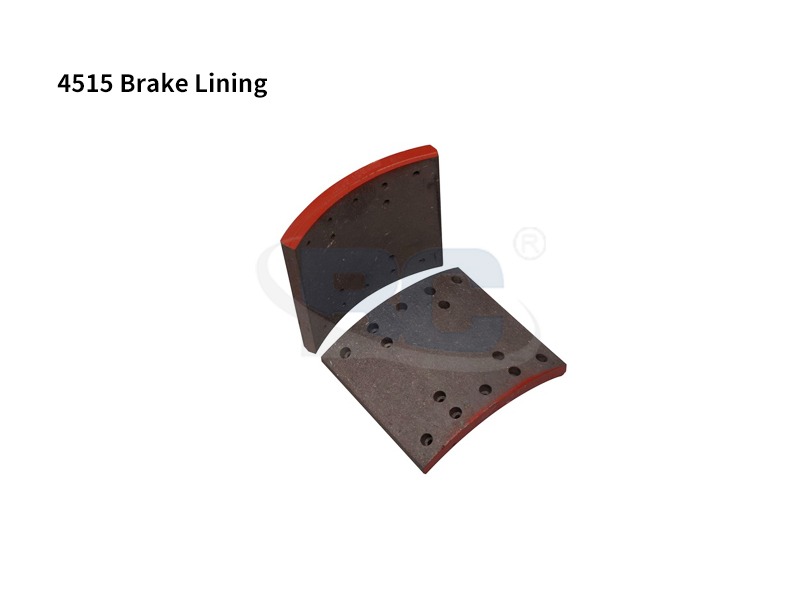 4515 Brake Lining with 16.5" x 7" Size and WVA 19036/37 CodeSized at 16.5 inches by 7 inches with 16 rivet holes, this FMSI 4515 lining is specified to match the shoe for a tested assembly, carrying WVA number 19036/37 for traceability.View Product →
Require quality evidence and batch traceability
Quality certificates and traceability are the evidence chain that confirms a brake shoe lot meets the RFQ; without them, the buyer accepts the risk of a silent material change. Procurement teams should ask for each item in the list below before the award, and again with every delivery.
- IATF 16949 certification of the manufacturing site, with the audit scope covering brake shoes.
- Material test certificate for the steel or casting heat number.
- Lining bond shear test records for the production batch.
- Hardness inspection report with measured values and the drawing reference.
- Batch marking on each shoe: FMSI number, production date code, and purchase order number.
For markets regulated by FMVSS 121, request dynamic performance data for the lining family, not only static dimensions. A manufacturer operating under IATF 16949 with a dedicated brake shoe line is the baseline; a supplier that cannot produce batch records in a readable format is a supply risk regardless of price.
Procurement rule
Do not let incoming quality clear the first article alone. Send the first-article report to the engineer who wrote the drawing tolerances; two pairs of eyes catch more discrepancies than one.
Lock down packaging, marking, and delivery
Packaging and delivery terms determine whether brake shoes arrive rust-free and ready to install, so they belong in the RFQ just as much as the metallurgy. A bare steel shoe that leaves the factory clean and arrives pitted is a quality failure caused by a packaging gap.
Rust protection and labeling
Require vapor corrosion inhibitor paper around each carton, edge protectors on the shoe ends, and a moisture barrier between the carton and the pallet. Each shoe should carry a stamped or labeled FMSI number and batch code; loose linings need the same identification on the box label.
MOQ and lead time
State the minimum order quantity per FMSI number and the mixed-batch flexibility the buyer expects. A typical production window for a container order of mixed steel brake shoes is 30 to 45 days after drawing confirmation; casted shoes run longer because of the casting cycle. Put the late-delivery escalation trigger in the RFQ, not in a later email argument.
Evaluate the supplier behind the quotation
The cheapest quotation is seldom the cheapest installed cost. Evaluate the supplier's production capacity, quality system, and FMSI/OEM coverage before approving the award; the list of platforms a manufacturer can support is a direct measure of competence.
Zhejiang Bangchi Auto Parts Co., Ltd., for example, operates a dedicated heavy-duty brake shoe line with an annual capacity of two million brake shoes and 20 years of brake product experience. Its catalogue covers BPW, Volvo, MAN, DAF, Hino, Nissan, and SAF platforms under the FMSI numbering system, so tooling and inspection fixtures for standard references already exist. A supplier with that depth can usually produce a drawing-compliant first article faster than a small workshop. Read the full capability statement in the company profile before sending the RFQ package.
- Check the audit scope of the quality certificate, not only the certificate name.
- Request a first-article inspection report before mass production.
- Confirm the ability to mix FMSI numbers in one container.
- Ask how the supplier handles drawing revisions and engineering changes.
Send the drawing file, the FMSI/OEM reference list, and the required certificates together. A complete RFQ shortens the quotation cycle; a supplier that answers with technical questions is more likely to deliver a fit-for-purpose part than one that quotes without asking any. Contact the sales engineering team if you need help structuring the specification package.
Brake shoe RFQ frequently asked questions
What is an FMSI number and why does it matter in a brake shoe RFQ?
An FMSI number is a standardized friction material index number that identifies the lining profile and shoe geometry. It matters because it gives suppliers an unambiguous cross-reference to the exact shoe platform, eliminating confusion caused by brand-specific part numbers such as 0509127830 for BPW or 3095196 for Volvo.
Should I specify riveted or bonded linings in the RFQ?
Yes. State the attachment method and the acceptance value. Riveted linings suit fleets that replace linings without changing shoes; bonded linings need a shear strength figure, typically at least 3.0 MPa after thermal aging, to avoid separation in high-temperature braking.
What lead time should a brake shoe RFQ allow?
As a planning figure, a mixed batch of bare steel brake shoes typically needs 30 to 45 days after drawing and sample confirmation; casted shoes run longer because of the casting and machining cycle. State the required delivery window and the escalation trigger in the RFQ itself.
What documents should a brake shoe supplier provide with the quotation?
The quotation should include the material test certificate, the IATF 16949 audit scope for brake shoes, the lining bond shear test record, the hardness inspection report, and a dimensional first-article report. Batch marking on each shoe ties the delivered parts back to those documents.