 English
 简体中文
简体中文Every custom brake shoe lining project starts with a concrete brake problem: a drum worn to its wear limit, an axle generation that changed mid-production, or a friction material that fades under heavy payload. The supplier that solves it has to control the metal shoe platform, the friction compound, and the finished assembly under one roof.
What Custom Brake Shoe Lining Means in Production Terms
Custom brake shoe lining is the engineering of a shoe platform, friction material, and finished assembly as one matched braking system, rather than as separately sourced parts.
A brake shoe lining is the replaceable friction surface attached to the outer arc of a brake shoe. In custom work, its compound formula, thickness, attachment method, and ground profile are specified for a particular vehicle, axle, and duty cycle.
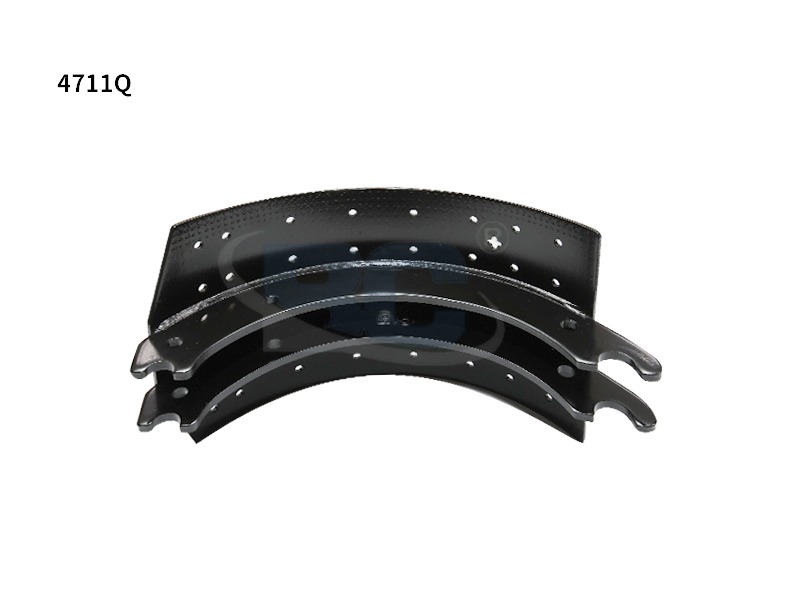
FMSI numbers provide the geometric reference. Numbers such as 4515, 4707, and 4709 define the template of the shoe and its lining, so a 4707Q shoe from two different suppliers should share the same base profile. What the FMSI number does not define is the friction material recipe, and that is where customisation actually begins.
The custom specification is built from three variables that the OE number does not fully describe:
- Friction coefficient target, set by axle load, road speed, and stopping frequency.
- Lining thickness and finished outside diameter, which determine the drum clearance.
- Edge chamfer and contact contour, which control noise and wear distribution.
Friction Material Selection Sets the Performance Limits
The lining compound decides every measurable braking result, from friction coefficient and fade temperature to wear rate and drum compatibility, so material selection comes before the shoe profile is confirmed.
Four material classes cover most heavy-duty drum brake applications:
| Lining class | Friction coefficient | Continuous temperature limit | Typical heavy-duty use |
| Non-asbestos organic (NAO) | 0.30 - 0.38 | 350 C | Light trucks and trailers |
| Semi-metallic | 0.35 - 0.45 | 450 C | Regional haul and higher payloads |
| Low-steel | 0.38 - 0.48 | 500 C | Long-haul tractors and severe braking |
| Ceramic hybrid | 0.40 - 0.50 | 550 C | Mining and off-road axles |
Long-haul tractor applications usually settle on a semi-metallic or low-steel recipe because the coefficient stays stable near 0.40 as drum temperature rises. Non-asbestos organic compounds are quieter but fade earlier, which is why they appear mainly on lighter axles.
When the application calls for a proven base material, a standard 4515 brake lining can be ordered with a different compound or thickness without changing the FMSI template.
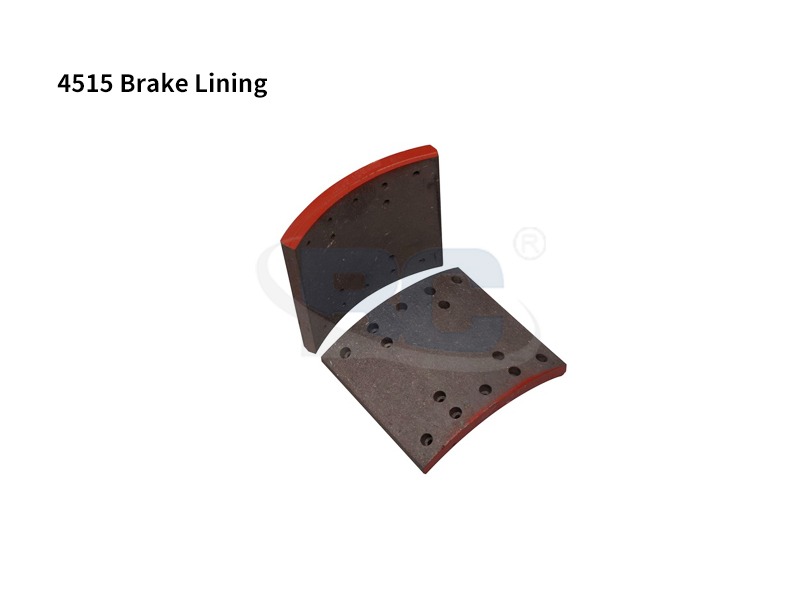 Custom 4515 Brake Lining OEM Manufacturers, Exporter, CompanyZhejiang Bangchi Auto Parts Co., Ltd. Is China Custom 4515 Brake Lining OEM Manufacturers, Exporter, Company, Part Number:4515 Brake Lini...View Product →
Steel and Casted Platforms, Two Structural Routes to the Same Fitment
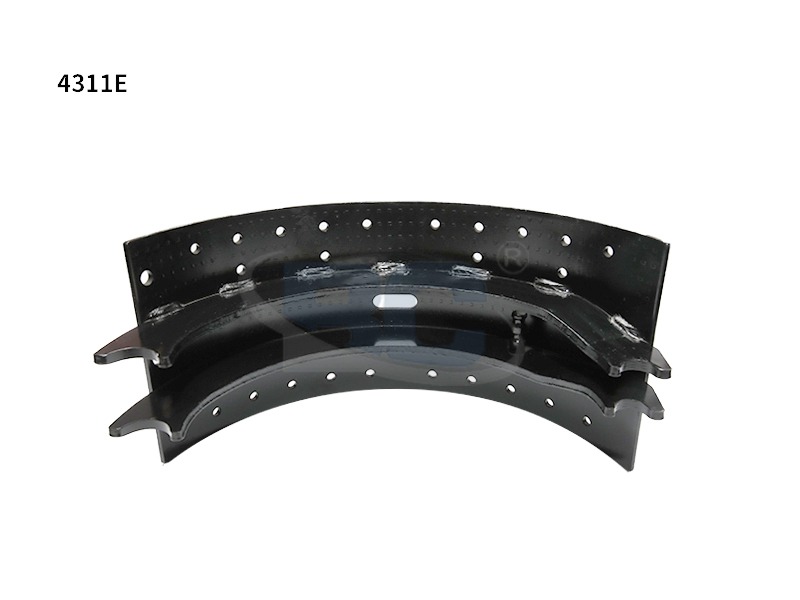
The shoe platform sets the mechanical ceiling of the assembly, and the choice between steel and casted construction changes how the shoe handles heat, deflection, and braking torque.
- Formed from high-strength steel strip and welded at the web
- Predictable elastic deflection and lower weight per shoe
- Well suited to high-volume profiles such as 4515 and 4591
- The standard choice for most drum brake platforms
- Cast in one piece with integrated ribs and contours
- Higher rigidity and better vibration damping
- Allows complex shapes that cannot be stamped
- Common on BPW, SAF, and heavy steer axles
In custom work, the platform drawing matters more than the marketing term. The same FMSI number can exist in both constructions, with 2 to 3 mm more metal in the casted web. Fitment stays identical, but weight and thermal capacity differ.
For operators on standard truck and trailer axles, the 4515Q steel brake shoe remains the most requested platform in the range.
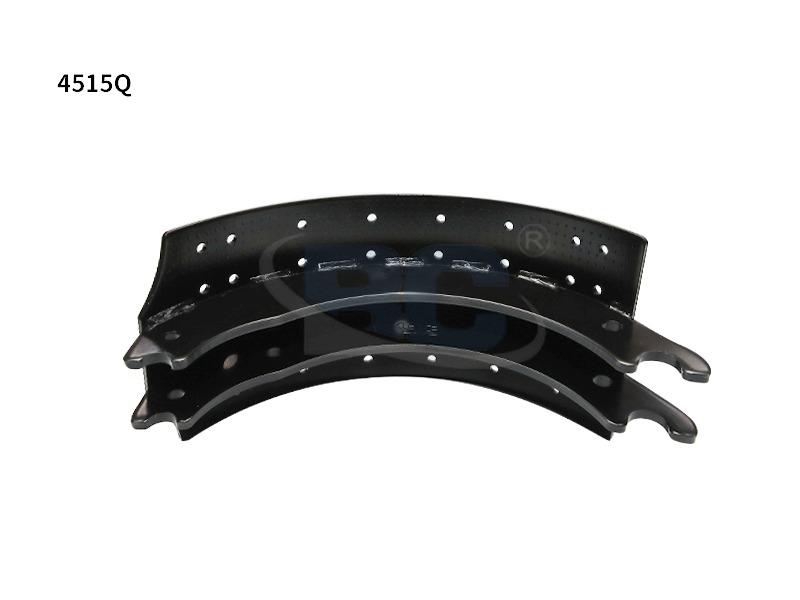 Custom 4515Q Brake Shoe OEM Manufacturers, Exporter, CompanyZhejiang Bangchi Auto Parts Co., Ltd. Is China Custom 4515Q Brake Shoe OEM Manufacturers, Exporter, Company, Part Number:4515Q Product Si...View Product →
Replacement rule: if the original part is stamped steel, replace it with steel. If it is casted, replace it with casted. Mixing platforms on the same axle changes the brake balance between the left and right wheels.
How Custom Lined Brake Shoes Are Manufactured
Custom lined shoe production follows five controlled stages, each with an inspection point, so the finished shoe matches the OE profile and the customer's friction target.
- Platform confirmation: the FMSI or OE number, drum diameter, shoe width, and web design are verified against the drawing.
- Friction material selection: compound class, lining thickness, and riveted or bonded attachment are fixed.
- Bonding and assembly: adhesive is applied and cured, or rivets are set at a controlled depth and spacing.
- Grinding and contouring: the lining outside diameter, taper, and chamfer are machined to the specified drum clearance.
- Final inspection: lining thickness, shoe opening, and rivet depth are recorded against the batch data.
The dimension that matters most is the ground outside diameter of the lined shoe. A difference of a few tenths of a millimetre shifts the eccentric position inside the drum, which changes the push-out point of the brake and the pressure distribution across the friction surface.
For fleets already running the 4707Q platform, ordering a 4707Q lined shoe assembly removes the alignment step entirely and shortens installation time.
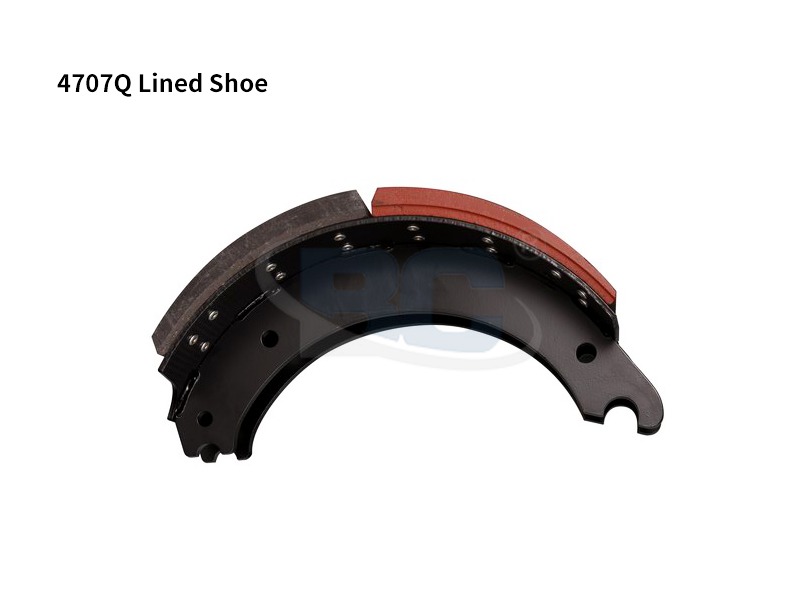 Custom 4707Q Lined Brake Shoe OEM Manufacturers, Exporter, CompanyZhejiang Bangchi Auto Parts Co., Ltd. Is China Custom 4707Q Lined Brake Shoe OEM Manufacturers, Exporter, Company, Part Number:4707Q Prod...View Product →
Inspection point: measure the lined shoe outside diameter and rivet depth before installation. Both values are defined in the custom specification, and both affect the final brake feel.
Supplier Qualification Defines Repeatable Quality
A custom lining solution is only as repeatable as the factory behind it, because the same FMSI number can be produced with very different dimensional and metallurgical discipline.
Zhejiang Bangchi Auto Parts Co., Ltd. is a Chinese heavy-duty brake parts manufacturer that has produced brake shoes since 2016, led by a founding team with more than twenty years of experience in friction and brake products. Every product family, including steel brake shoes, casted brake shoes, brake linings, lined shoes, repair kits, and lined shoe kits, is produced under the IATF 16949 quality system, and ordering is organised around FMSI numbering.
The certification history, product scope, and capacity figures are documented in the company profile for buyers who need to verify the supplier before sending a drawing.
Custom Brake Shoe Lining FAQ
Custom brake shoe linings are ordered by FMSI or OE number plus a specified friction material, thickness, and attachment method. Buyers who want a quick overview of the process usually start with the ordering FAQ before sending their drawings.
What information is needed for a custom brake shoe lining quote?
Provide the FMSI or OE part number, the shoe platform (steel or casted), drum diameter and width, lining thickness, and the duty cycle. Include axle generation details such as old or new, because several platforms changed dimensions between generations.
Can lined brake shoes be built for BPW, SAF, Volvo, and MAN axles?
Yes. The production range covers BPW 420 x 200, SAF SK9 420 x 180, Volvo VL 410 x 225 x 8, and MAN 160 and 220 platforms, plus DAF, Hino, and Nissan axles, in steel and casted construction and in air or oil brake versions where the axle family requires them.
What is the difference between riveted and bonded linings?
Riveted linings are mechanically fastened, which allows faster field re-lining and gives an audible wear warning as the lining reaches the rivet heads. Bonded linings use high-temperature adhesive, provide more usable friction material, and are preferred when the full lining thickness must be available for grinding.
How does FMSI numbering help when ordering custom linings?
FMSI, the Friction Materials Standards Institute, assigns numbers that define the geometric template of a brake shoe and its lining. With the FMSI number as the base, the supplier can match the platform and adjust the compound, thickness, and finish without re-engineering the shoe.
The fastest way to start a custom brake shoe lining project is to send the FMSI or OE number together with your duty data. The engineering team will confirm material grade, lining thickness, and dimensional feasibility before any tooling is discussed. To move forward, contact the engineering team directly.