 English
 简体中文
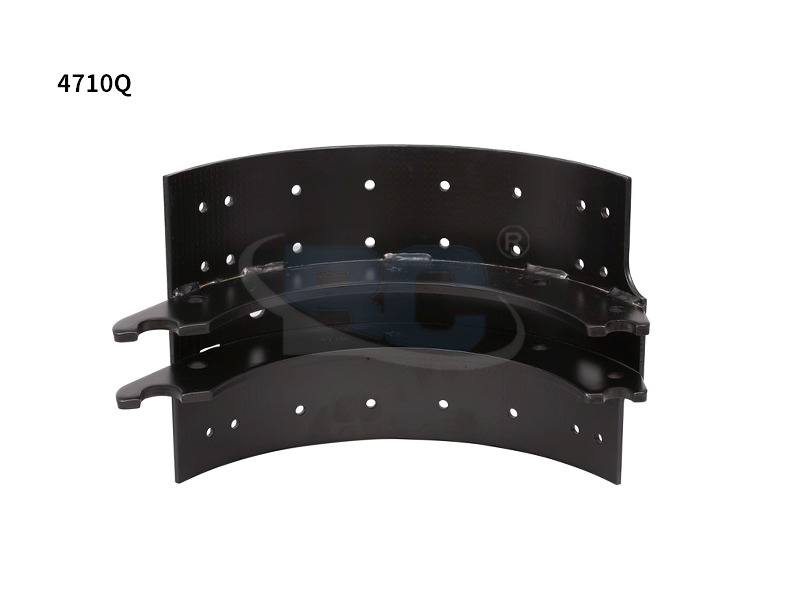
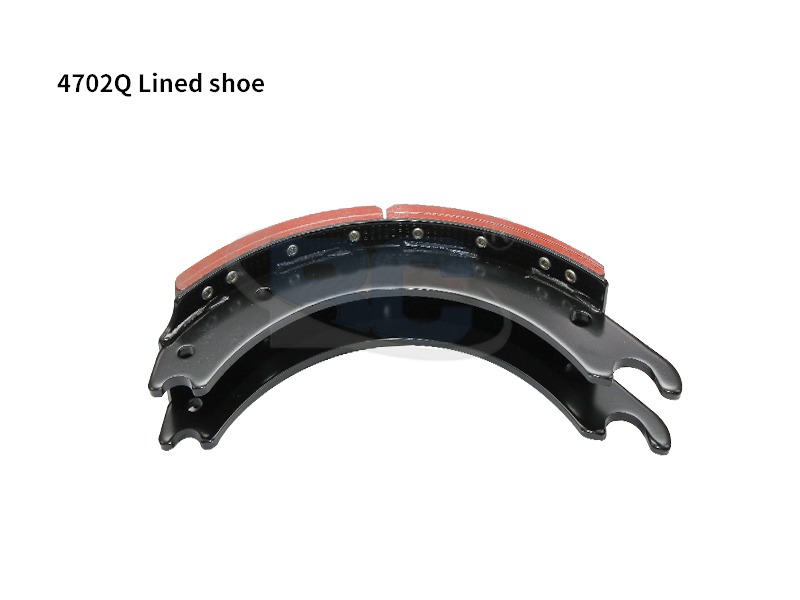
简体中文The 4710Q brake shoe is a heavy-duty drum brake shoe assembly used primarily on commercial trailers, semi-trailers, and heavy trucks that operate under the US Federal Motor Vehicle Safety Standards (FMVSS) and Canadian Motor Vehicle Safety Standards (CMVSS) brake performance requirements. It is a direct-mount, pre-assembled unit combining a fabricated steel platform (the shoe table and web) with a friction lining bonded or riveted to the curved shoe table face. The "Q" suffix in 4710Q designates a specific lining friction code classification under the SAE J661 standard — identifying the friction material's coefficient range and heat characteristics.
If you are sourcing a 4710Q brake shoe, the critical facts are: it fits the standard 16.5-inch × 5-inch brake drum configuration used across the majority of North American Class 6–8 heavy trucks and trailers, it is interchangeable across multiple axle positions, and the friction material grade determines stopping performance, heat fade resistance, and lining wear rate — all of which vary significantly between OEM and aftermarket suppliers.
What the 4710Q Part Number Means
The 4710Q designation follows the Gunite / Accuride / industry-standard brake shoe numbering convention used across the North American heavy-vehicle brake parts market. Breaking down the number provides immediate fitment and specification information:
- 47 — Identifies the shoe platform width category. In the standard coding, this prefix group covers shoes designed for the 5-inch (127 mm) wide brake drum face, which is the dominant width on standard tandem drive axles and trailer axles in North American applications.
- 10 — Identifies the drum diameter category. This corresponds to the 16.5-inch (419 mm) drum diameter — the universal standard for Class 7 and Class 8 truck and trailer axles in North America. This diameter has been the predominant size since the mid-20th century and remains the standard against which all replacement parts are sourced.
- Q — The SAE J661 friction code designation. The Q code identifies a friction lining with a specific coefficient of friction and heat performance range. Under J661, each letter corresponds to a tested coefficient range: Q falls in the normal friction category (0.35–0.45 coefficient of friction), balanced for both cold and hot braking performance under heavy commercial vehicle loads.
Cross-reference numbers for the 4710Q vary by manufacturer. The same assembly may appear in supplier catalogues as Meritor 4710Q, Gunite 4710Q, Haldex 4710Q, or under OEM part numbers from Hendrickson, Dana Spicer, and axle OEMs. Always verify the web thickness, shoe table arc, and lining attachment method (bonded vs. riveted) against the original equipment specification before ordering from a new supplier, as dimensional variations between foundries can affect drum-to-lining clearance and adjuster compatibility.
4710Q Brake Shoe Technical Specifications
The following specification table covers the key dimensional and performance parameters for a standard 4710Q brake shoe assembly. Values shown represent the OEM-equivalent specification; verify against your specific axle manufacturer's documentation for safety-critical applications.
| Parameter | Specification | Notes |
|---|---|---|
| Drum Diameter | 16.5 in (419 mm) | Standard Class 7–8 truck/trailer |
| Shoe Width | 5.0 in (127 mm) | Full-width lining face |
| Shoe Table Arc Radius | 8.25 in (209.6 mm) | Half of drum diameter — must match drum |
| Web Thickness (typical) | 0.25–0.31 in (6.4–7.9 mm) | Varies by manufacturer; inspect for minimum |
| Friction Code (SAE J661) | Q (0.35–0.45 CoF) | Both cold and hot coefficient in Q range |
| Lining Attachment | Riveted (standard) or bonded | Riveted preferred for heavy-duty cycling |
| Minimum Lining Thickness | 0.25 in (6.35 mm) — replace at this point | FMVSS 121 minimum; many fleets replace at 3/8 in |
| Operating Temperature Range | Up to 500°F (260°C) continuous | Fade onset above 600°F on standard Q lining |
| Compatibility | S-cam foundation brake — standard slack adjuster | Not for wedge or disc brake systems |
Vehicle and Axle Applications for the 4710Q
The 4710Q is one of the most widely specified brake shoes in the North American heavy vehicle market. Its 16.5 × 5 configuration covers the majority of tandem drive and trailer axle positions on Class 6, 7, and 8 vehicles. Common confirmed applications include:
- Semi-trailer axles: Standard equipment on most 5th-wheel trailers, refrigerated trailers, and flatbeds using Hendrickson, SAF-Holland, and Dexter axle assemblies. The 4710Q fits both leading and trailing shoe positions on S-cam foundation brakes in these axle families.
- Class 8 tractor drive axles: Used on Meritor RS series rear tandem axles — among the most common Class 8 drive axles — as well as Dana Spicer DS series and ArvinMeritor squeal-dampened variants. The shoe fits both primary and secondary positions.
- Medium-duty trucks (Class 6–7): Rear axle drum brake systems on International MV Series, Freightliner M2, and Kenworth T270/T370 trucks where the 16.5-inch drum diameter is specified. Front axle applications on Class 8 trucks use a different drum width (7 or 8 inches) and require a different shoe number.
- Buses and coaches: Rear axle drum brakes on transit and coach bus platforms using standard Meritor/ZF axle configurations, where drum diameter and shoe width match the 4710 family specification.
- Construction and vocational equipment: Dump trucks, concrete mixers, and crane carriers using highway-spec tandem rear axles with 16.5-inch drums. Note: severe-service vocational applications may warrant a higher-grade friction lining than the standard Q code — consult the friction supplier's application guide.
To confirm fitment on a specific vehicle, measure the drum diameter and drum face width at the next brake inspection, and record the axle OEM and model number from the axle tag. Cross-reference these against the 4710Q specification — drum diameter 16.5 inches, shoe width 5 inches — before ordering.
OEM vs. Aftermarket 4710Q: What the Quality Difference Looks Like
The 4710Q is a commodity part in the heavy truck aftermarket, which means quality ranges widely between suppliers. The physical dimensions may look identical between a premium OEM-equivalent shoe and a low-cost import, but the performance difference under loaded braking conditions is substantial and has direct safety implications.
- Steel platform quality: OEM-specification 4710Q shoes use high-strength low-alloy (HSLA) steel for the web and table, with a minimum yield strength of 50,000 psi (345 MPa). Budget aftermarket shoes may use mild steel (yield strength 36,000 psi / 248 MPa), which is more prone to web cracking under the cyclic bending loads imposed by heavy braking on loaded vehicles. Inspect for web cracks at the cam follower pocket and at the anchor pin hole — these are the highest-stress locations.
- Friction lining consistency: SAE J661 certification requires friction testing of the actual production lining, with the cold and hot coefficient falling within the Q designation band. Some low-cost suppliers certify one batch and produce subsequent batches with inconsistent formulation. Inconsistent friction coefficient across a set of shoes results in uneven brake application — the equivalent of having mismatched brake bias across the axle, causing pull, premature wear on the higher-friction shoe, and reduced total brake force from the lower-friction shoe.
- Lining-to-table bond integrity: Riveted linings must have rivet holes countersunk to the correct depth so the rivet head is fully recessed and cannot contact the drum surface before the lining reaches minimum thickness. Improperly countersunk rivets contact the drum 3–5 mm before the lining reaches minimum thickness, causing immediate drum scoring and the need for drum replacement in addition to shoe replacement.
- Arc grinding: The shoe table arc radius must match the drum radius to within 0.010 inches (0.25 mm) for full-face lining contact. A shoe with a mismatched arc contacts the drum only at the centre or edges, reducing effective braking area by up to 40% and causing accelerated localised lining wear.
Inspection, Wear Limits, and When to Replace the 4710Q
FMVSS 121 and CVSA (Commercial Vehicle Safety Alliance) roadside inspection criteria define the minimum conditions under which a 4710Q brake shoe must be replaced. Preventive fleet maintenance standards typically use more conservative thresholds to avoid roadside out-of-service violations and ensure consistent brake performance across the service interval.
- Minimum lining thickness: FMVSS 121 specifies replacement at 0.25 inches (6.35 mm) measured at the thinnest point, excluding any chamfer. Most fleet maintenance standards replace at 0.375 inches (9.5 mm) — the 3/8-inch rule — to ensure consistent performance through the next inspection interval and avoid emergency replacement on the road.
- Web cracking: Any crack in the shoe web — visible to the naked eye during a hands-on inspection — is an immediate discard criterion. Web cracks propagate rapidly under braking loads and can result in complete shoe collapse inside the brake drum, a catastrophic failure mode that causes total loss of braking on the affected wheel.
- Lining contamination: Grease or oil penetration into the lining matrix reduces the friction coefficient by 50–70% at the contaminated area. Contaminated linings cannot be cleaned and returned to service — replacement is mandatory. Identify and repair the source of contamination (failed axle seal, wheel bearing seal, or slack adjuster grease fitting overpacking) before installing new shoes.
- Lining delamination or chunking: Any lining section that has separated from the shoe table, cracked through its full thickness, or shows edge chunking is a replacement indicator regardless of measured thickness. Delaminated sections can wedge between the shoe and drum, causing brake lockup.
- Cam roller and anchor pin wear: The 4710Q shoe interacts with the S-cam through a roller at the cam end and pivots on the anchor pin at the fixed end. Worn or oval cam rollers and elongated anchor pin holes cause brake timing variation — the shoe does not fully retract, resulting in brake drag, heat buildup, and accelerated lining wear. Measure anchor pin hole diameter against specification at every shoe replacement.
Installation Best Practices for the 4710Q Brake Shoe
Installing a 4710Q brake shoe correctly determines whether the new shoes deliver their rated performance from the first brake application or require an extended bedding-in period with reduced effectiveness. These steps represent established commercial vehicle brake service practice:
- Replace in complete axle sets: Always replace all shoes on a complete axle (both wheels) simultaneously. Mixing new and partially worn shoes on the same axle creates a brake force imbalance that causes vehicle pull under heavy braking. The same principle applies to friction code — never mix Q-coded and differently coded linings on the same axle.
- Inspect and measure the drum before reassembly: Measure drum inside diameter at multiple positions using a drum micrometer. Maximum serviceable diameter for a standard 16.5-inch drum is typically 16.620 inches — check against the drum manufacturer's discard dimension stamped on the drum face. A drum at or near discard diameter should be replaced, not reused with new shoes — the combination produces rapid lining wear and inferior braking performance.
- Clean all hardware contact points: Remove old grease, corrosion, and brake dust from anchor pin, cam bushings, cam roller contact surfaces, and spider abutment pads before reassembly. Apply a thin film of high-temperature brake lubricant (not grease) to all metal-to-metal contact points — anchor pin bore, roller-to-cam contact, and spider abutment pads only. Do not apply any lubricant to the friction lining face or drum braking surface.
- Set initial slack adjuster adjustment correctly: After installation, manually back off the slack adjuster to provide approximately 0.020–0.030 inch (0.5–0.75 mm) lining-to-drum clearance, confirmed by checking that the drum rotates freely with light drag but without binding. Automatic slack adjusters (ASAs) should self-adjust to operating clearance after the first few brake applications — verify stroke at the brake chamber pushrod does not exceed 1.75 inches (44.5 mm) at full brake application.
- Perform a brake burnish (bedding procedure): New linings require a controlled bedding cycle to transfer a thin, uniform film of friction material onto the drum surface and seat the lining arc to the drum. The standard commercial vehicle burnish procedure involves 20–30 moderate stops from 30 mph, allowing the brakes to cool between applications. Avoid heavy braking for the first 200–300 miles of operation. Skipping this procedure results in glazed linings and reduced friction for the first portion of the lining service life.