 English
 简体中文
简体中文A buyer receives a batch of lined brake shoes with the same FMSI number as last year’s order. The price per set looks good, the boxes arrive on time, and the lining surface looks smooth enough. Three weeks later, a fleet workshop reports a soft brake pedal on one truck and uneven lining wear on another. The parts look identical, but the measured performance is not.
That scenario is common because brake shoe lining quality is not a single number stamped on a box. It is the result of four separate areas that must be verified before production: the friction material itself, the dimensional accuracy of the lined assembly, the structural strength of the metal shoe, and the factory controls that keep every batch consistent. Buyers who check these areas are less likely to discover the difference after installation.
What Brake Shoe Lining Quality Really Depends On
Friction Coefficient and Thermal Endurance
The friction coefficient, expressed as μ, is the lining’s ability to convert brake pressure into stopping force. Heavy-duty truck linings commonly operate in the 0.35 to 0.45 range, while severe-duty applications may climb higher. Under the ECE R90 letter code, a Grade F lining covers 0.35–0.45 and Grade G covers 0.45–0.55. A GG-rated lining holds braking force better under sustained heat, but it is not automatically the right choice for every truck. The correct grade must match the vehicle’s gross weight, drum material, and typical operating terrain.
Fleet buyers sometimes assume that a higher friction grade means better quality. In practice, an over-specified lining can generate aggressive bite, elevated drum temperatures, and faster wear on both components. A reliable supplier should declare the friction rating on the product data sheet, not leave it to guesswork. For example, the 4707 brake lining with a declared friction rating gives buyers a clear starting point when comparing replacement material against the original specification.
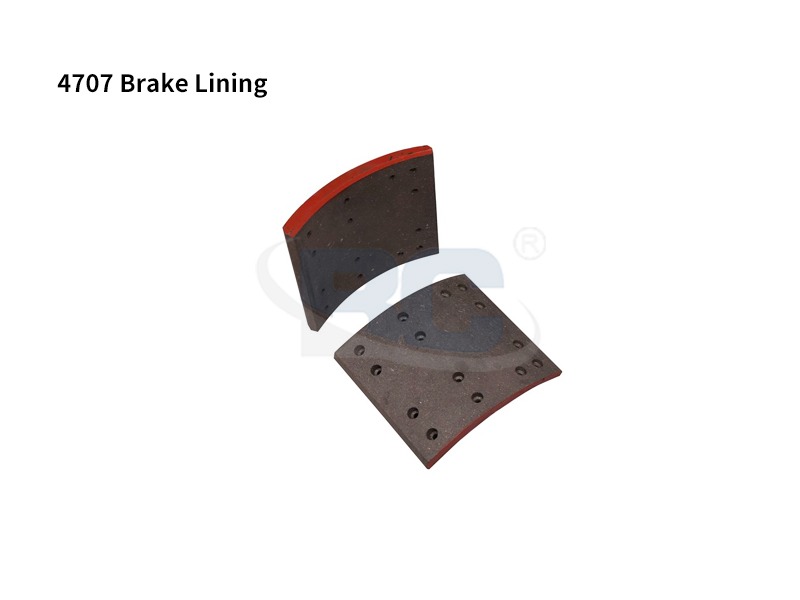 Custom 4707 Brake Lining OEM Manufacturers, Exporter, CompanyZhejiang Bangchi Auto Parts Co., Ltd. Is China Custom 4707 Brake Lining OEM Manufacturers, Exporter, Company, Part Number:4707 Brake Lini...View Product →
Wear Balance, Shear Strength, and Density
Wear resistance only matters if the lining wears at a rate that protects the brake drum. An excessively hard lining can score a drum surface, and replacing a drum costs far more than replacing a lining. That is why quality standards focus on a balanced wear rate rather than maximum longevity. Shear strength is equally important: it measures how well the lining stays bonded to the shoe under braking loads. Density influences porosity, noise behavior, and how evenly the lining bed-in with the drum. A manufacturer should be able to supply batch test data covering these properties, not just a material description.
| Grade | Typical μ Range | Typical Duty | Selection Note |
|---|---|---|---|
| E | 0.25–0.35 | Light to medium commercial duty | Rarely specified for heavy trucks |
| F | 0.35–0.45 | Linehaul, general freight, standard heavy-duty | Most common replacement grade |
| G | 0.45–0.55 | Heavy haul, logging, severe stop-and-go | Higher bite, more thermal stress on drums |
Dimensional Accuracy: The Difference Between “Fits” and “Fits Correctly”
FMSI Profiles Are Geometry, Not Just a Part Number
An FMSI number identifies a defined lining profile, including the arc, thickness, hole positions, and locating slots. Two linings with the same FMSI number may both be labeled as interchangeable, but their actual geometry can differ significantly if the manufacturer uses loose tolerances. Camber deviation, thickness drift, or a worn profile template can turn a supposedly standard part into a source of uneven contact, high pedal effort, and premature wear. The inspection method matters too: checking a lining with calipers at two points is not enough. The profile should be verified against an FMSI template to confirm the full contour.
Lining-to-Drum Contact and Total Tolerance
Initial contact area between a new lining and the brake drum is one of the strongest indicators of how a brake will behave during the first few thousand kilometres. In well-made assemblies, the contact area should be well above 80 percent; lower contact creates localized pressure, early glazing, and a brake pedal that feels inconsistent. Thickness tolerance also affects axle balance. If the left wheel receives a lining that is slightly thinner than the right, the vehicle can pull under braking. This is why a complete lined shoe assembly, such as the 4707Q lined brake shoe assembly verified against the FMSI profile, is a stronger choice for fleets that want predictable installation results rather than a bin of loose parts.
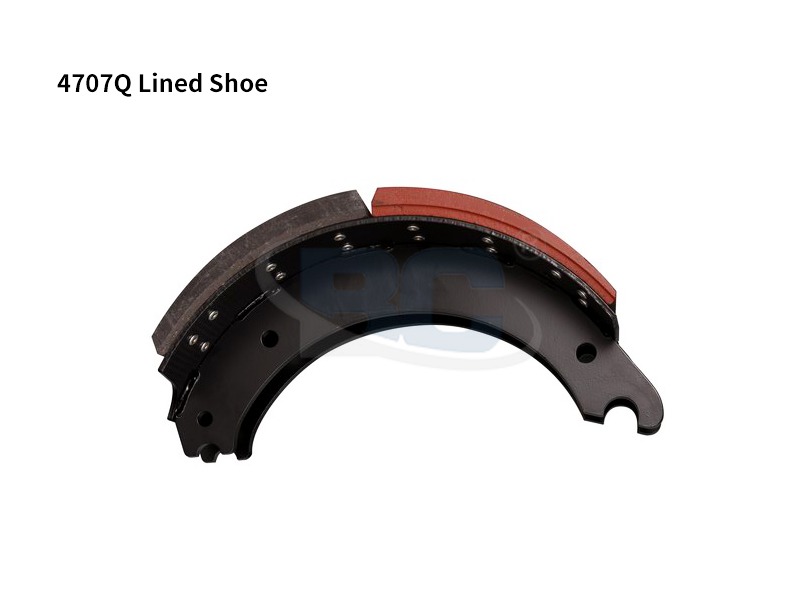 Custom 4707Q Lined Brake Shoe OEM Manufacturers, Exporter, CompanyZhejiang Bangchi Auto Parts Co., Ltd. Is China Custom 4707Q Lined Brake Shoe OEM Manufacturers, Exporter, Company, Part Number:4707Q Prod...View Product →
The Metal Brake Shoe Underneath the Lining
Cast Construction Versus Steel Construction
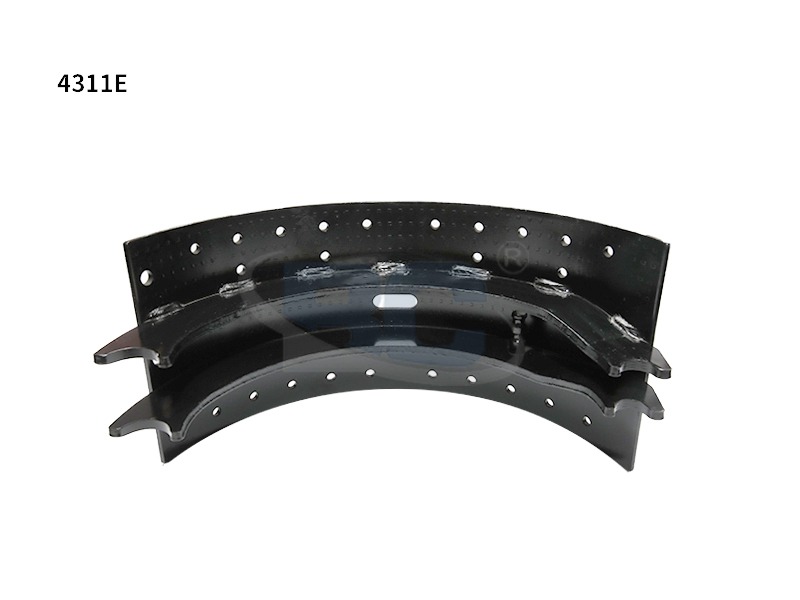
Metal shoe bodies are generally divided into two manufacturing approaches. Steel brake shoes are stamped and welded, which gives consistent mechanical properties and good ductility for standard load applications. Cast brake shoes are poured as a single piece, offering higher rigidity and the ability to form complex contours around cam surfaces and anchor points. The right choice depends on the axle design and operating load, not on which process sounds more advanced. A shoe body that flexes under high brake torque reduces the effective contact between lining and drum, regardless of how good the friction material is. For heavy-duty axle applications that demand stiffness, a 4715 casted brake shoe for heavy-duty axle service is often the more appropriate starting point in a specification review.
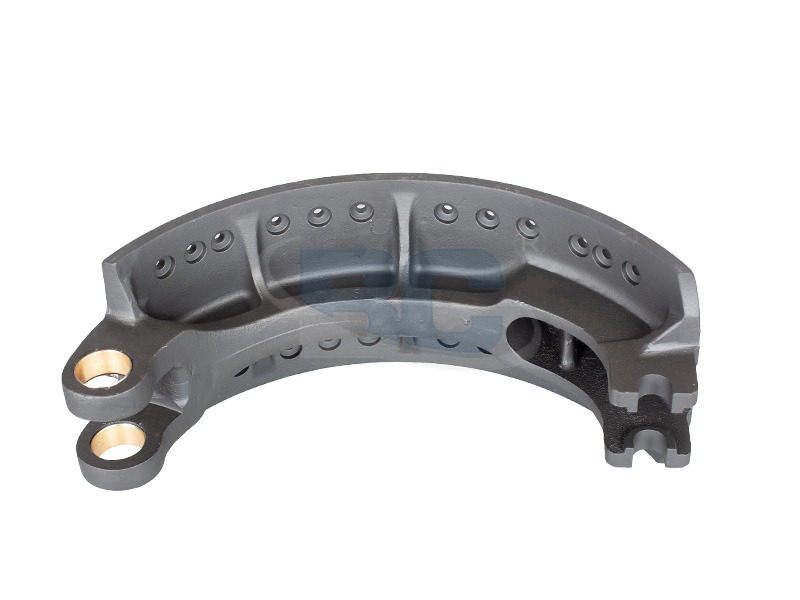 Custom 4715 Casted Brake Shoe OEM Manufacturers, Exporter, CompanyZhejiang Bangchi Auto Parts Co., Ltd. Is China Custom 4715 Casted Brake Shoe OEM Manufacturers, Exporter, Company, Part No:4715 OEM No: S...View Product →
Surface Preparation and Deformation Limits
Even a new shoe body can be a source of lining failure if its surface is not prepared correctly. Welding heat can distort a steel shoe, leaving a small gap between the lining and the shoe table. Shot blasting residue can contaminate the bonding surface. Anti-rust oil applied to the shoe can migrate under the lining and reduce shear strength. These problems are not visible after the lining is riveted or bonded, so they are frequently missed during incoming inspection. A simple check on a flat table, or a dial indicator sweep across the shoe table, can reveal distortion before installation. When lining wear appears abnormal, the metal shoe should be examined before blaming the friction material.
Factory Quality Control: What Should Happen Before the Parts Are Packed
System Certification and Process Control
IATF 16949 certification does not replace product testing, but it does force a manufacturer to control production variables that directly affect lining quality: mixing ratios, curing temperature curves, pressing pressure, and lot separation. It also provides the documentation trail that a serious buyer can audit. Zhejiang Bangchi’s company profile describes how IATF 16949 governs its brake shoe production system, including the process controls behind each batch. When a supplier can show process records rather than just a certificate, the quality statement becomes verifiable.
Lot Traceability and Batch Release Testing
Brake lining performance is not something that can be judged visually. A qualified factory should test incoming friction material for density, hardness, and shrinkage, then record curing parameters during production, and finally sample finished linings for shear strength and dimensional accuracy. Each batch needs a traceable lot number linked to the material records and the vehicles that received those parts. Without this chain of data, the lining is a black box, and the buyer only discovers the performance after installation. A manufacturer that can produce batch documentation for every FMSI number is showing that its quality standard is an ongoing process, not a one-time inspection.
A Practical Buyers’ Checklist for Lined Brake Shoes
Documents to Request Before You Commit
- A friction grade declaration with the applicable test reference, such as ECE R90 or an equivalent standard.
- An FMSI template conformity report covering the lining profile, thickness, and hole positions.
- Batch test data for density, hardness, and shear strength on the friction material.
- A surface condition statement for the metal shoe body, including welding, cleaning, and coating details.
- Installation data such as rivet specifications, bonding requirements, and recommended torque values.
These documents cost nothing to request, but they quickly separate manufacturers who control their process from those who simply assemble parts. The heavy-duty brake shoe FAQ on this site also answers common questions about interchangeability and installation expectations for different FMSI numbers.
Sample Validation on a Real Vehicle
Documentation confirms capability, but a sample installation confirms reality. Mount a test set on one axle, use the same lining grade on both sides, and record cold and hot braking performance, pedal feel, and noise. A few hundred kilometres of controlled running will reveal more than a stack of data sheets. The goal is not to find the cheapest part, but to find the part that performs within the vehicle’s original design parameters. If a manufacturer is confident in its quality standards, it will provide samples and discuss the test results. Use the manufacturer’s contact page to request current specifications before making a larger purchasing commitment.
Brake shoe lining quality comes down to four verifiable areas: friction material behavior, dimensional conformity to the FMSI profile, structural integrity of the metal shoe, and factory controls that ensure batch consistency. Buyers who evaluate all four areas before ordering reduce the risk of soft pedals, uneven wear, and premature drum damage. The data that proves quality should be available before the purchase, not discovered after installation.