 English
 简体中文
简体中文What "Quality" Means for a Brake Shoe Lining
Quality in brake shoe lining manufacturing is not a single test result. It is the consistency of friction performance, thermal stability, dimensional accuracy, and mechanical integrity across every batch a plant ships, and a buyer evaluating a supplier should look for evidence of all four.
Friction consistency comes first. Heavy-duty truck linings are typically formulated to hold a friction coefficient between 0.35 and 0.45, and the manufacturer's acceptance window is roughly 0.05 above or below the target across the full temperature range. If friction drifts outside that window, drivers experience weak braking or grabby, uncomfortable brake response, and the lining wears unevenly.
Thermal stability matters just as much. Lining fade, the loss of friction at high temperature, is a leading contributor to heavy-truck braking emergencies on long downhill grades. A quality-verified lining keeps its friction drop between 100 C and 300 C inside the declared window instead of falling away sharply when the drum heats up.
Raw Material Control: Where Quality Is Decided
Every quality defect found in a finished lining can be traced back to a raw material decision made weeks earlier, which is why incoming material inspection is the first line of defense. A brake lining formulation is built from four families of ingredients, and each one needs defined acceptance checks before it enters production.
- Resin binders, usually phenolic: incoming lots are checked for gel time, viscosity, and free phenol content.
- Reinforcement fibers such as aramid, glass, and mineral wool: length distribution, tensile strength, and moisture content are logged.
- Friction modifiers, including abrasives and solid lubricants: particle size distribution and chemical purity are verified by sieve analysis.
- Fillers and compounding aids: density, oil absorption, and color consistency are compared against the approved supplier specification.
Every incoming lot carries a unique batch code that links the raw material delivery to the finished lining part number. If a complaint comes back from the field, the manufacturer can trace the failed part to the supplier, the delivery date, and the test certificate within minutes. Under IATF 16949 rules, that traceability is auditable, not optional.
Manufacturing Process: Controlled at Every Step
Once approved materials reach the production floor, quality is decided by process discipline: a documented procedure for every stage, a logged parameter for every cycle, and a verified output check after every operation. The control points are the same whether the plant builds linings only or complete lined brake shoes.
- Weighing and mixing: the formulation is weighed to a tolerance of 0.5 percent and blended in a timed high-shear cycle. Mixer logs record cycle time, blade speed, and mix temperature.
- Molding: the preformed mix is pressed into green linings under controlled pressure and mold temperature. Press parameters are recorded per cycle and reviewed daily.
- Curing: linings are baked on a staged heating schedule that removes volatiles and cross-links the resin matrix. Oven profile data is archived per batch.
- Grinding and finishing: surfaces are ground to the specified thickness tolerance, and a sample from every batch is measured against the FMSI drawing for thickness, width, and arc radius.
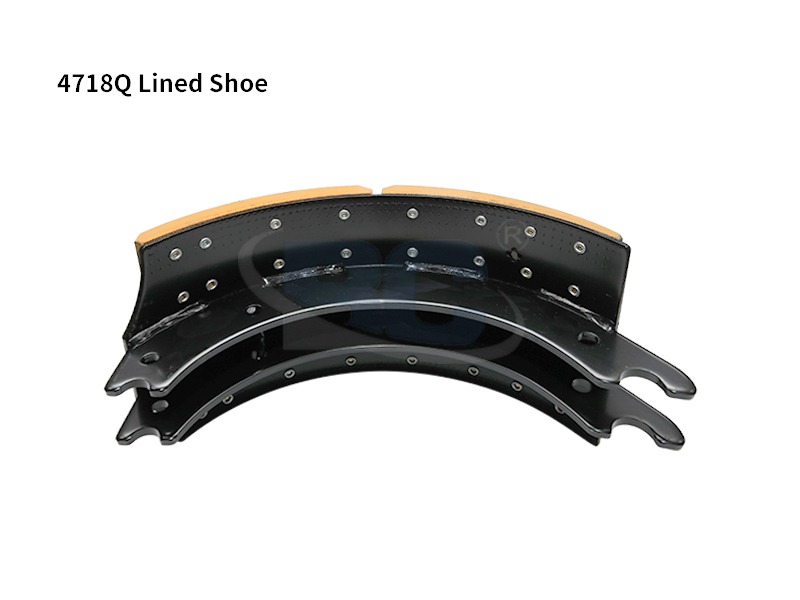
- Assembly for lined shoes: riveting torque, countersink depth, and hole alignment are inspected, along with the gap between the lining and the shoe web.
- Marking and packaging: the FMSI number, batch code, and date of manufacture are marked permanently on each part, completing the traceability loop.
The same discipline applies to the metal side of the brake shoe. Steel shoes must hold web-to-platform squareness and rivet hole positions inside the drawing tolerance, and that is a job for measurement fixtures, not for visual inspection. On parts such as the 4709ES2 steel brake shoe, dimensional checks run on a dedicated gauge at the end of the machining line.
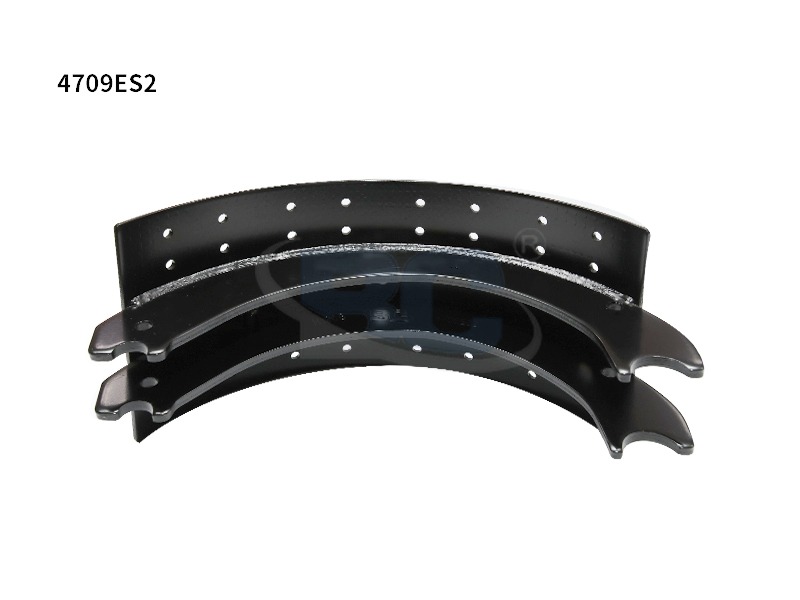 Custom 4709ES2 Brake Shoe OEM Manufacturers, Exporter, CompanyZhejiang Bangchi Auto Parts Co., Ltd. Is China Custom 4709ES2 Brake Shoe OEM Manufacturers, Exporter, Company, Part Number:4709ES2 Produc...View Product →
Testing: What Gets Measured Before Shipment
No lining leaves a quality-controlled plant without passing a defined battery of laboratory tests, and the acceptance thresholds are specific and measurable. The criteria below represent the core release tests used for heavy-duty replacement linings.
| Test | What it verifies | Typical acceptance |
| Shear strength | Lining-to-web adhesion | Min 12 MPa, no delamination |
| Friction and fade | Mu stability from 100 C to 300 C | Within 0.05 of target value |
| Wear rate | Long-haul service life | Max 0.2 mm per 1,000 km |
| Dimensional inspection | Thickness, width, arc radius | Per FMSI drawing tolerance |
| Rivet pull (lined shoes) | Mechanical retention | No loosening at rated load |
Laboratory results are confirmed with a sample from every production batch, not only when a new formulation is introduced. Batch-level sampling is what turns a good material recipe into a dependable aftermarket product, because it catches process drift before it reaches the customer.
Even a straightforward replacement part such as the 4515 brake lining must pass the complete shear, fade, and dimensional sequence before it reaches the warehouse. The tests are not reserved for product development; they are the routine gate for every batch.
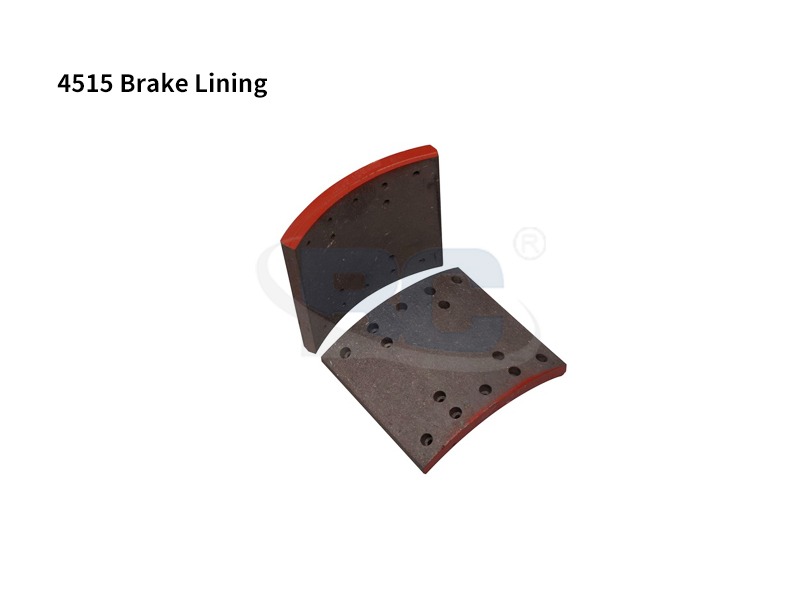 Custom 4515 Brake Lining OEM Manufacturers, Exporter, CompanyZhejiang Bangchi Auto Parts Co., Ltd. Is China Custom 4515 Brake Lining OEM Manufacturers, Exporter, Company, Part Number:4515 Brake Lini...View Product →
Dimensional Tolerances and FMSI Compliance
An FMSI number is a promise: a lining that carries a given number must match every other lining with the same number for form, fit, and friction behavior. FMSI, the Friction Materials Standards Institute, publishes the reference geometry that defines each part number, and a manufacturer that prints an FMSI number on a box is declaring that the part conforms to that reference.
The critical dimensions on a heavy-duty lining are thickness, width, arc radius of the friction surface, and the position and depth of rivet holes or chamfers. Thickness is typically controlled to about 0.10 mm above or below the drawing value. Slot and chamfer geometry is equally important because it affects noise, dust evacuation, and initial bedding behavior.
For replacement applications such as the 4707Q lined brake shoe, rivet countersink depth and the gap between the lining and the shoe web are checked on every sample pulled from the batch. Those two measurements decide whether the shoe installs into existing drum hardware without modification.
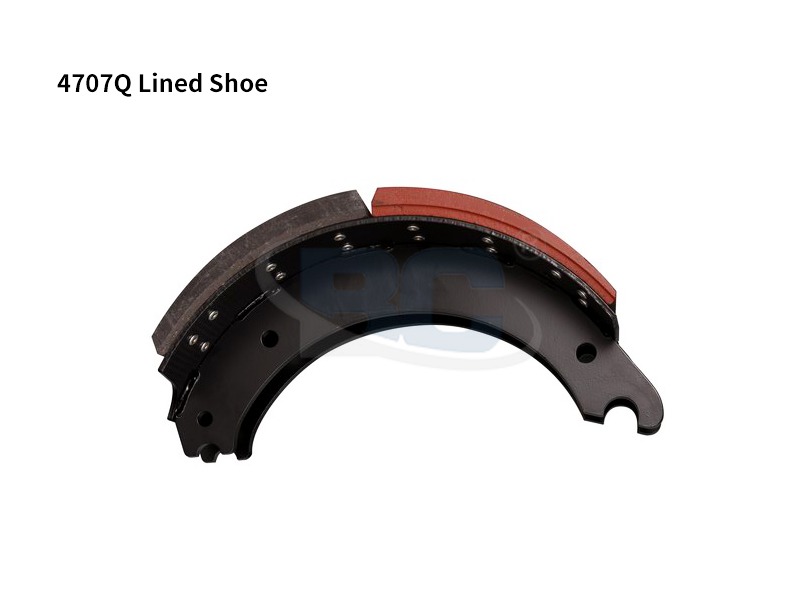 Custom 4707Q Lined Brake Shoe OEM Manufacturers, Exporter, CompanyZhejiang Bangchi Auto Parts Co., Ltd. Is China Custom 4707Q Lined Brake Shoe OEM Manufacturers, Exporter, Company, Part Number:4707Q Prod...View Product →
Certification, Audits, and Verified Traceability
A quality claim is only as strong as the certification standing behind it, and for brake components that certification is IATF 16949. An IATF 16949:2016-certified plant has passed a documented, third-party audit of its quality management system: control plans, failure mode analysis, supplier approval, calibration records, and employee training files are all examined, and the certificate is maintained through annual surveillance audits.
Zhejiang Bangchi Auto Parts Co., Ltd. completed its transition to the new-version IATF 16949:2016 certification audit, putting its heavy-duty brake shoe and lining production under the same quality system used across the global automotive supply chain. A buyer can ask for the certificate number, the certification body, and the last audit date, and a legitimate manufacturer will provide all three without hesitation. The full history of the quality system is documented on its company profile page.
Frequently Asked Questions
What is the most important quality test for a brake shoe lining?
The shear strength test ranks first because it verifies that the lining stays bonded to the shoe web under load. The typical acceptance threshold for heavy-duty linings is a minimum of 12 MPa with no delamination, sampled from every batch.
How does FMSI numbering relate to quality?
An FMSI number defines the form, fit, and friction characteristics of a lining. Quality is confirmed when the manufactured part matches the FMSI drawing tolerances, typically 0.10 mm above or below on thickness, so it installs and performs like the reference part.
What certification should a brake shoe lining manufacturer hold?
The relevant system certification is IATF 16949:2016, maintained through annual third-party surveillance audits. Buyers should request the certificate, the certification body, and the recent audit date rather than accepting a verbal claim.
How often are production batches tested?
Quality-controlled plants test a sample from every batch for shear strength, friction stability, and dimensional accuracy, not only during formulation development. Batch-level sampling catches process drift before defective parts reach customers.
More answers on selection, maintenance, and replacement are collected on the frequently asked questions page.